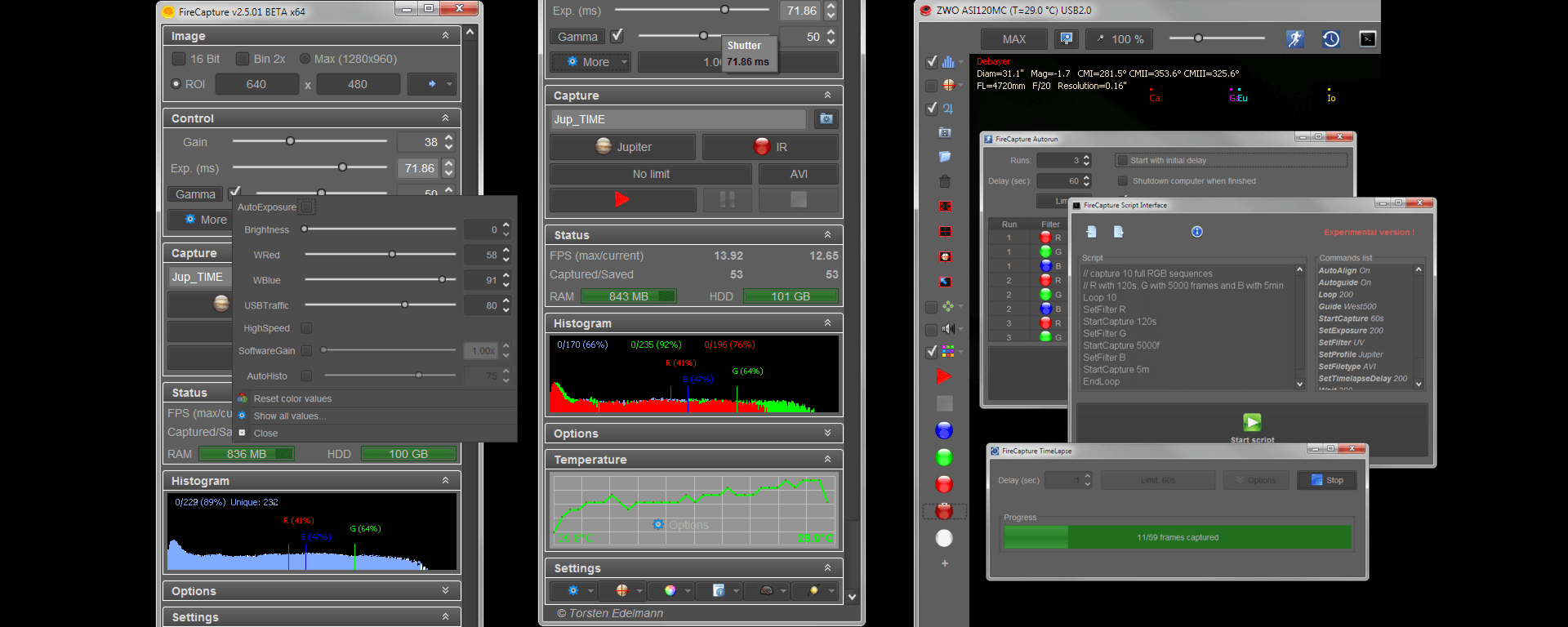
Raspberry support for FireCapture v2.6 and ZWO cameras !
| Compatibility |  FC v2.7.15 (x64) |
 FC v2.7.15 (x64) |
 FC v2.7.15 (x64) |
FC v2.7.15 (aarch64) |
|
|---|---|---|---|---|---|
 Altair Altair |
 |
 |
|
|
|
 ASCOM ASCOM |
 |
|
|||
 Basler Basler |
|
|
|||
 FLIR/FlyCap FLIR/FlyCap |
 |
|
|||
| FLIR/Spinnaker |
|
|
|||
 LUCID LUCID |
|
|
|||
 NexImage NexImage |
|
|
|||
 OGMA OGMA |
|
|
|
|
|
 PlayerOne PlayerOne |
|
|
|
|
|
 QHY QHY |
|
|
|
|
|
 Skyris Skyris |
|
|
|||
 SVBony SVBony |
|
|
|
|
|
 TIS
TIS |
|
|
|||
 Touptek/Omegon Touptek/Omegon |
|
|
|
|
|
 ZWO ASI ZWO ASI |
 |
|
|
|
|
Older Versions
Developing software is mostly fun, but it also takes up nearly all of my spare time. If you find FireCapture useful and would like to support me in continuing development you're welcome to donate a small amount of your choice.


Mara held the walkman and felt the weight of an absent parent in the warped plastic. She passed it to the man with the cart. He opened the cassette, found a half-recorded lullaby that sounded like their softened loop, and fed it into the grid. When the serenade swelled, the boy’s shoulders dropped, as if a long, remembered shape had filled the space behind him. He smiled, an honest bright thing. He had not known his father’s voice in years; now it braided into the alley’s chorus, anonymous and particular together.
“You weaponize memory,” Mara said.
Mara sat on a milk crate and watched him work. He let the slider settle at -3. The serenade lost some of its teeth and gained a roundness, like pennies rolling in a jar. Voices knit into choruses. It reminded Mara of her mother’s lullaby — not the melody itself but the feeling of being wrapped. Tears came without warning. She didn’t wipe them. Around them, the alley’s residents — swollen-eyed, tired-limbed — breathed in the softened loop like a shared benediction.
They adapted again. The man shifted the code into forms harder to persecute: recordings spread via old USBs left in library books, melodies embedded as background hums in laundromat machines, sequences hidden inside the cadence of buskers playing six-block away. It was insidious in the way kindness sometimes is: small acts that accumulated into something bigger than any single ordinance could snip.
He studied her as if tasting a new spice. The idea shifted something in his jaw. He reprogrammed a patchwork of filters — frequency bands that only opened when a certain number of people gathered, geofences keyed to corners known for caretaking. He coded the module to bloom the lullaby near soup kitchens and closed it down near gilded apartments. He left a small, sharp thread exposed: a knock of discord that would appear once in a while, to remind people there was an edge if they ignored the song for too long.
But memory has teeth that can cut whoever holds it. One night Mara traced a particularly sharp thread to a downtown court where the landlord sat during a hearing. He’d been called out on unpaid repairs mentioned in the serenade’s loops. The landlord pressed charges in retaliation. The city tightened legal screws: noise ordinances, public disturbance statutes, laws that meant little when enforced against people without money for lawyers. Messages started circulating among the alley residents — cease, or risk eviction and worse.
Mara held the walkman and felt the weight of an absent parent in the warped plastic. She passed it to the man with the cart. He opened the cassette, found a half-recorded lullaby that sounded like their softened loop, and fed it into the grid. When the serenade swelled, the boy’s shoulders dropped, as if a long, remembered shape had filled the space behind him. He smiled, an honest bright thing. He had not known his father’s voice in years; now it braided into the alley’s chorus, anonymous and particular together.
“You weaponize memory,” Mara said.
Mara sat on a milk crate and watched him work. He let the slider settle at -3. The serenade lost some of its teeth and gained a roundness, like pennies rolling in a jar. Voices knit into choruses. It reminded Mara of her mother’s lullaby — not the melody itself but the feeling of being wrapped. Tears came without warning. She didn’t wipe them. Around them, the alley’s residents — swollen-eyed, tired-limbed — breathed in the softened loop like a shared benediction. cruel serenade gutter trash v050 bitshift work
They adapted again. The man shifted the code into forms harder to persecute: recordings spread via old USBs left in library books, melodies embedded as background hums in laundromat machines, sequences hidden inside the cadence of buskers playing six-block away. It was insidious in the way kindness sometimes is: small acts that accumulated into something bigger than any single ordinance could snip. Mara held the walkman and felt the weight
He studied her as if tasting a new spice. The idea shifted something in his jaw. He reprogrammed a patchwork of filters — frequency bands that only opened when a certain number of people gathered, geofences keyed to corners known for caretaking. He coded the module to bloom the lullaby near soup kitchens and closed it down near gilded apartments. He left a small, sharp thread exposed: a knock of discord that would appear once in a while, to remind people there was an edge if they ignored the song for too long. When the serenade swelled, the boy’s shoulders dropped,
But memory has teeth that can cut whoever holds it. One night Mara traced a particularly sharp thread to a downtown court where the landlord sat during a hearing. He’d been called out on unpaid repairs mentioned in the serenade’s loops. The landlord pressed charges in retaliation. The city tightened legal screws: noise ordinances, public disturbance statutes, laws that meant little when enforced against people without money for lawyers. Messages started circulating among the alley residents — cease, or risk eviction and worse.
It was back in 2008 when I got hold of a SONY newsletter announcing a new CCD sensor (ICX618) which promised fantastic sensitivity. Still working with an old webcam those days I instantly had the idea of replacing the webcam sensor with the new SONY sensor. It took weeks and dozens of emails to get the confidential spec of the new sensor. When I saw the sensitivity values it was clear: I had to have this sensor! The Basler Scout scA640 was the first machine vision camera on the market using this sensor and when I bought it the nightmare began: the included software was useless for planetary imaging and running the camera with the VRecord webcam tool was a complete PITA. Bugged by the inability to store even the basic camera settings I decided developing my own capture software.
What started as a solely private project soon turned into higher gear when fellow astronomers saw the software and insisted on getting it. I decided to make it public, included new camera interfaces and after years of continuous development FireCapture has evolved to one of the leading planetary capture tools. Developing the thing is only one part of the story: with a supportive community of users behind me I always had the feeling of someone 'looking over my shoulder' during the countless hours of programming. I can't mention all but just want to say:
Thank you guys !