Dongle Emulator Wilcom Embroidery Studio E3 — 22
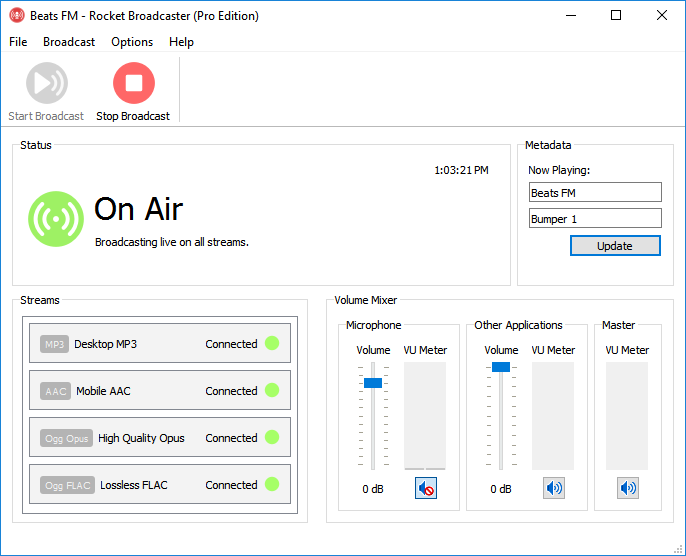
Rocket Broadcaster streams audio to Icecast, SHOUTcast, RSAS, and most online streaming services.
 Download for Free
For Windows 7 or later.

Rocket Broadcaster streams audio to Icecast, SHOUTcast, RSAS, and most online streaming services.
Download for Free
For Windows 7 or later.
This major update adds the brand new Broadcast Audio Processor, an automatic configuration backup system, and improved connectivity for Radio Mast.

Rocket captures audio from other applications, including Skype, Spotify, and your automation software, so you can seamlessly mix live interviews with music.
Broadcast to Icecast, Icecast-kh, Shoutcast 1 & Shoutcast 2, RSAS, and compatible streaming servers.

Broadcast audio as MP3, Ogg Vorbis, and Ogg Opus. Upgrade to PRO for AAC, AAC+, HE-AAC v1, and lossless Ogg FLAC.
Automatically capture metadata from your favorite media player.

Rocket automatically reconnects your streams in case there's a problem.

If you have two internet connections, Rocket can simultaneously stream over your backup link for extra reliability.








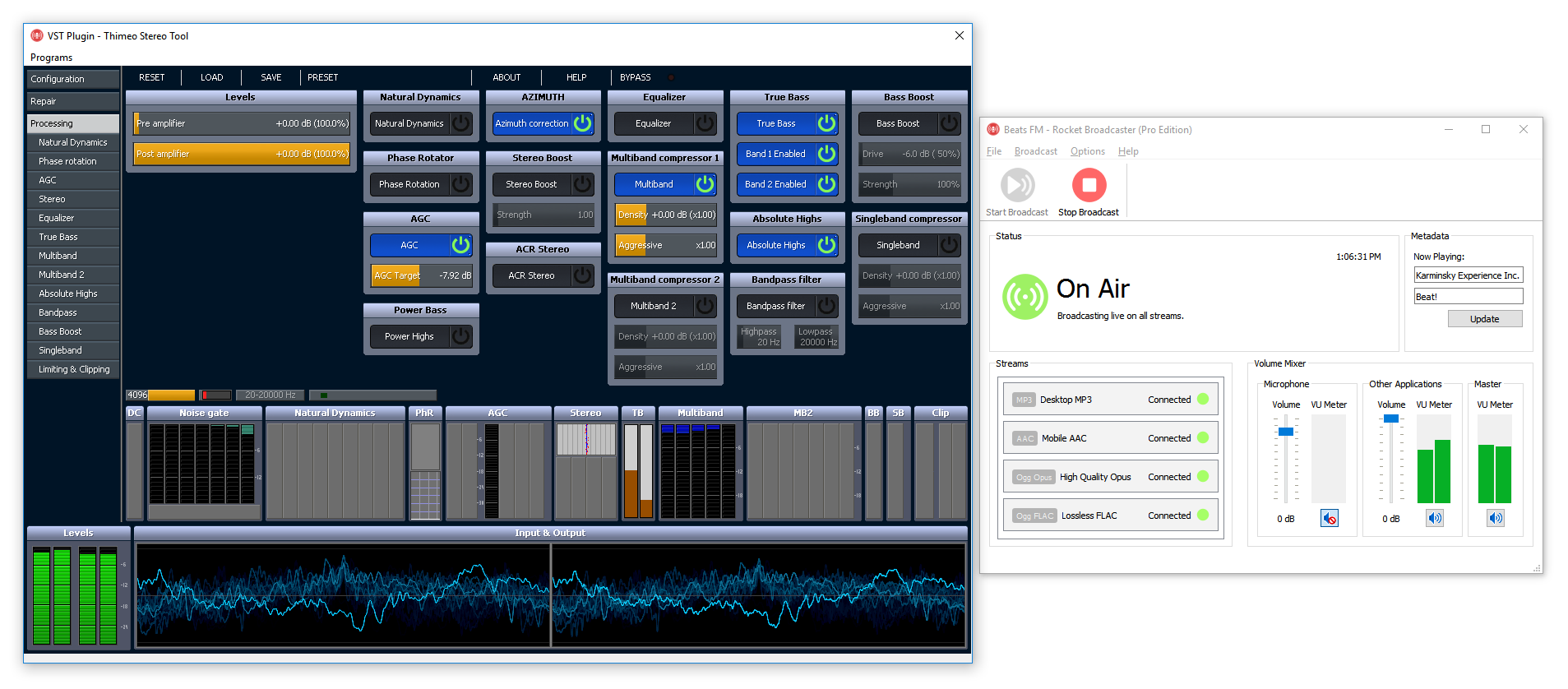
Shape your station's signature sound with the brand new built-in Broadcast Audio Processor.
Shape your sound with the Multiband Compressor, AGC, and Limiter. Easy presets help you get started quickly.
Automatically keeps your stream at a consistent loudness using our ITU BS.1770 Loudness Meter and hybrid Automatic Gain Control.
Process your sound without crushing your PC. Optimized for minimal CPU and memory usage, and only 15 ms of added latency.
Refine your station's audio with third party DSP processing plugins like Stereo Tool.
Rocket Broadcaster works with all streaming providers using Icecast, Icecast-KH, SHOUTcast, or Rocket Streaming Audio Server (RSAS) including:
Requires Windows 7 or later.
Rocket Broadcaster is a modern replacement for Edcast, Oddcast DSP, BUTT, and Darkice, and is designed for professional use.
Emily's heart sank. She knew that the dongle was a small hardware device that acted as a key to unlock the software, and without it, she couldn't work. She had misplaced it a few days ago while working on a project, and now she was facing a tight deadline.
The next morning, Emily received a call from a new client, interested in her embroidery services. With her Wilcom Embroidery Studio E3 up and running smoothly, courtesy of the dongle emulator, Emily was ready to take on the challenge and showcase her skills. And as she worked on the new project, she couldn't help but feel grateful for the little-known solution that had helped her overcome a major hurdle. Dongle Emulator Wilcom Embroidery Studio E3 22
A dongle emulator was a software that could mimic the presence of the physical dongle, allowing her to use the software without the actual device. Emily quickly searched for a reliable dongle emulator online and found one that claimed to be compatible with Wilcom Embroidery Studio E3. Emily's heart sank
With trembling fingers, Emily downloaded and installed the emulator. She followed the instructions carefully, and to her relief, the software began to work as if the dongle was present. She let out a sigh of relief and dove back into her work, grateful to have found a solution. The next morning, Emily received a call from
For the rest of the day, Emily worked seamlessly on her embroidery projects, thanks to the dongle emulator. She finished her tasks on time and even managed to take on a few more projects, feeling more confident and productive.
It was a typical Monday morning for Emily, a freelance embroiderer who worked from home. She fired up her computer and opened Wilcom Embroidery Studio E3, her go-to software for designing and editing embroidery patterns. However, as she tried to access the program, she was greeted with a frustrating message: "Dongle not found."
Panicked, Emily searched every nook and cranny of her workspace, but the dongle was nowhere to be found. She tried to recall the last time she had used it, but her mind was a blank. Just as she was about to give up, she remembered a forum post she had read online about a dongle emulator.
Emily's heart sank. She knew that the dongle was a small hardware device that acted as a key to unlock the software, and without it, she couldn't work. She had misplaced it a few days ago while working on a project, and now she was facing a tight deadline.
The next morning, Emily received a call from a new client, interested in her embroidery services. With her Wilcom Embroidery Studio E3 up and running smoothly, courtesy of the dongle emulator, Emily was ready to take on the challenge and showcase her skills. And as she worked on the new project, she couldn't help but feel grateful for the little-known solution that had helped her overcome a major hurdle.
A dongle emulator was a software that could mimic the presence of the physical dongle, allowing her to use the software without the actual device. Emily quickly searched for a reliable dongle emulator online and found one that claimed to be compatible with Wilcom Embroidery Studio E3.
With trembling fingers, Emily downloaded and installed the emulator. She followed the instructions carefully, and to her relief, the software began to work as if the dongle was present. She let out a sigh of relief and dove back into her work, grateful to have found a solution.
For the rest of the day, Emily worked seamlessly on her embroidery projects, thanks to the dongle emulator. She finished her tasks on time and even managed to take on a few more projects, feeling more confident and productive.
It was a typical Monday morning for Emily, a freelance embroiderer who worked from home. She fired up her computer and opened Wilcom Embroidery Studio E3, her go-to software for designing and editing embroidery patterns. However, as she tried to access the program, she was greeted with a frustrating message: "Dongle not found."
Panicked, Emily searched every nook and cranny of her workspace, but the dongle was nowhere to be found. She tried to recall the last time she had used it, but her mind was a blank. Just as she was about to give up, she remembered a forum post she had read online about a dongle emulator.
