Peter's electronic projects Peter's electronic projects
Ending on a positive note, showing the successful resolution and strengthened client relations. Maybe include a lesson or insight from the experience.
Plot development: Alex discovers that the link issue is due to a configuration error or a security protocol. Maybe there's an underlying issue like a third-party service's API change. The climax involves resolving the error, testing, and ensuring the link works. The resolution brings the website back online, restoring Nursultan's business operations.
Setting the scene: Maybe Nursultan is a business owner whose critical online service is failing due to a broken link. The protagonist, let's say a tech consultant named Alex, is called in urgently. The challenge is to find out why the link keeps breaking.
The “Nursultan client crack link” became a case study in tech circles—both for the cunning attack and the ingenuity of the fix. Years later, SkyBridge’s “LinkGuard” protocol, designed by Alex’s team, became a gold standard in regional cybersecurity.
Themes: Trust between client and professional, the importance of attention to detail, overcoming technical challenges. Need to make sure the story is engaging, maybe add some tension like a ticking clock before a server crashes.
Check for coherence, make sure the technical aspects are plausible but not too jargon-heavy. Aim for a balance between storytelling and a realistic problem-solving scenario.
I need to create a narrative around this. Let's think of Nursultan as a client who needs help. The story should involve a challenge related to a broken link, which the protagonist (maybe a consultant or a tech expert) needs to fix. The story should highlight problem-solving, trust, and resolution.
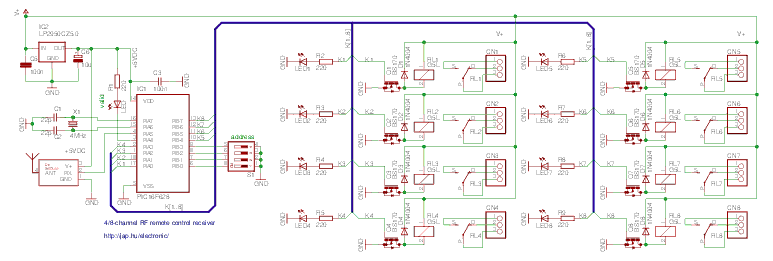
 Try it now, before building! Click on the transmitter buttons with the
green
labels
on the left and see how the receiver outputs (K1-K8) change. Change
the number of transmitter or receiver channels. Switch the receiver
output type between latched and momentary.
Try it now, before building! Click on the transmitter buttons with the
green
labels
on the left and see how the receiver outputs (K1-K8) change. Change
the number of transmitter or receiver channels. Switch the receiver
output type between latched and momentary.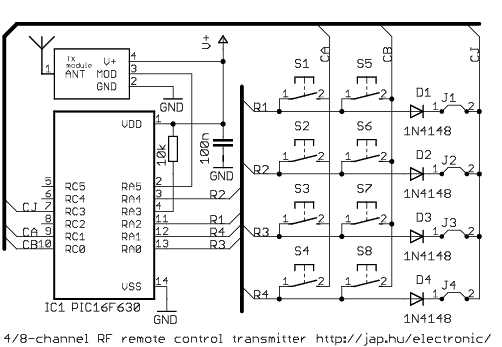
| part | description |
| C1 |
100nF ceramic capacitor |
| R1 |
10k resistor (1/8W) |
| D1-D4 | 1N4148 diode (optional) |
| S1-S8 |
tact switch, DTSM 61N or similar |
| IC1 | PIC16F630 or PIC16F676 microcontroller, pre-programmed |
| TXMOD |
radio
transmitter module, see text (hardware) |
| B1 |
battery between 2-5.5VDC (check TXMOD specs for valid voltage range) |
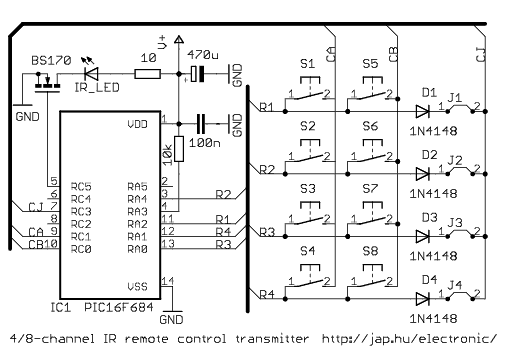
| part | description |
| C1 |
100nF ceramic capacitor |
| C2 |
470 uF 6.3V, electrolytic
capacitor |
| R1 |
10k resistor (1/8W) |
| R2 |
10 ohm resistor (1/4W) |
| D1-D4 | 1N4148 diode (optional) |
| D5 |
IR transmitter LED |
| Q1 |
BSS138 or similar N-MOSFET |
| S1-S8 |
tact switch, DTSM 61N or similar |
| IC1 | PIC16F684 microcontroller, pre-programmed |
| B1 |
battery between 2-5.5VDC (CR2032, 3.6V LiIon battery or 3xAA
batteries) |
| please
observe the corresponding address configuration! |
|
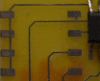 transmitter: no diodes connected |
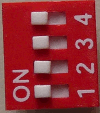 receiver: switches all ON |
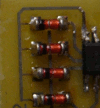 transmitter: all diodes connected |
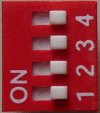 receiver: switches all OFF |
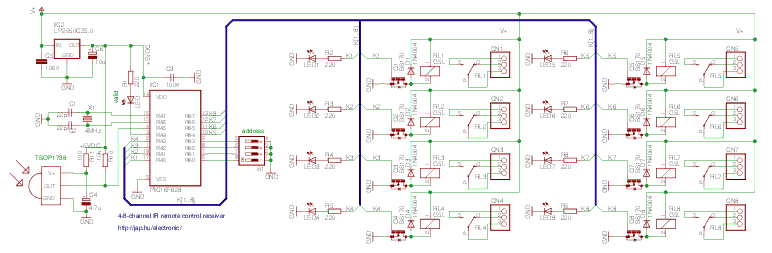
parts list
| part | description |
| C1, C2 | 22pF ceramic capacitor |
| C3, C5 | 100nF ceramic capacitor |
| C6 | 10uF 6.3V electrolytic capacitor |
| CN1-CN8 | PCB terminal block, 3-way (DG301) |
| D1-D8 | 1N4004 diode |
| IC1 | PIC16F627 or PIC16F628 or PIC16F627A or PIC16F628A microcontroller, pre-programmed |
| IC2 | LP2950CZ5.0 voltage regulator |
| LED | 3mm LED (green) |
| LED1-LED8 | 3mm LED (red) |
| Q1-Q8 | BS170 N-channel mosfet transistor |
| R1-R9 | 220R resistor (1/8W) |
| RL1-RL8 | G5LE relay, see text for coil voltage selection |
| S1 | piano DIP switch, 4-way |
| X1 | 4MHz HC49 crystal |
| RXMOD | 3-pin radio receiver module, see text (hardware) |
| please
observe the corresponding address configuration! |
|
| transmitter: no diodes connected |
receiver: switches all ON |
| transmitter: all diodes connected |
receiver: switches all OFF |
Ending on a positive note, showing the successful resolution and strengthened client relations. Maybe include a lesson or insight from the experience.
Plot development: Alex discovers that the link issue is due to a configuration error or a security protocol. Maybe there's an underlying issue like a third-party service's API change. The climax involves resolving the error, testing, and ensuring the link works. The resolution brings the website back online, restoring Nursultan's business operations.
Setting the scene: Maybe Nursultan is a business owner whose critical online service is failing due to a broken link. The protagonist, let's say a tech consultant named Alex, is called in urgently. The challenge is to find out why the link keeps breaking.
The “Nursultan client crack link” became a case study in tech circles—both for the cunning attack and the ingenuity of the fix. Years later, SkyBridge’s “LinkGuard” protocol, designed by Alex’s team, became a gold standard in regional cybersecurity.
Themes: Trust between client and professional, the importance of attention to detail, overcoming technical challenges. Need to make sure the story is engaging, maybe add some tension like a ticking clock before a server crashes.
Check for coherence, make sure the technical aspects are plausible but not too jargon-heavy. Aim for a balance between storytelling and a realistic problem-solving scenario.
I need to create a narrative around this. Let's think of Nursultan as a client who needs help. The story should involve a challenge related to a broken link, which the protagonist (maybe a consultant or a tech expert) needs to fix. The story should highlight problem-solving, trust, and resolution.
LATCH_MASK EQU B'00001111' sets channels 8-5 to momentary
and
channels 4-1 to latched (toggle) mode. Then use the compiler (MPLAB or
gputils) to
assemble the code.clrf
0x91 ;
ANSEL