Overtone
The Great Book Of Music Alfarabi Pdf Portable [repack]
"The Great Book of Music" is divided into several chapters, each addressing a specific aspect of music. The book begins with a discussion on the definition of music, its importance, and its relationship to other arts. Al-Farabi then describes the various types of musical instruments, including strings, winds, and percussion. He also explains the principles of melody, harmony, and rhythm, providing examples of different musical modes and scales.
Al-Farabi's "The Great Book of Music" is a seminal work on music theory, written in the 10th century. This treatise is considered one of the most important contributions to music theory in the Islamic Golden Age. The book is a comprehensive guide to music, covering various aspects of the art, including instruments, melodies, rhythms, and the emotional impact of music on the human soul. the great book of music alfarabi pdf portable
"The Great Book of Music" by Al-Farabi is a foundational text in music theory, offering insights into the art of music and its philosophical dimensions. This treatise has had a lasting impact on music theory and has influenced generations of music theorists and composers. While a portable PDF version may not be readily available, digital versions of the book can be accessed through various online resources. "The Great Book of Music" is divided into
Al-Farabi's work is not only a practical guide to music but also a philosophical treatise on the nature of music. He explores the emotional and psychological effects of music on the human soul, discussing how different melodies and rhythms can evoke various emotions and moods. This aspect of the book reflects Al-Farabi's interest in the philosophical and psychological dimensions of music, which was a hallmark of his philosophical approach. He also explains the principles of melody, harmony,
"The Great Book of Music" had a significant impact on the development of music theory in the Islamic world and beyond. The book was widely studied and translated, influencing music theorists and composers across the Middle East, North Africa, and Europe. Al-Farabi's work also influenced later music theorists, such as Ibn Sina (Avicenna) and Ibn Rushd (Averroes).
Examples
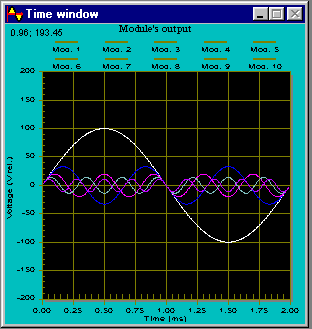
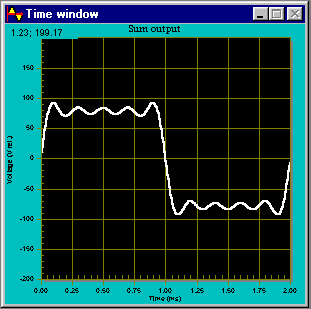
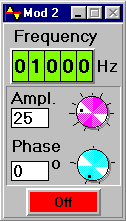
You can test the Helmholtz assumption that the relative phases of the overtones are irrelevant to hearing.
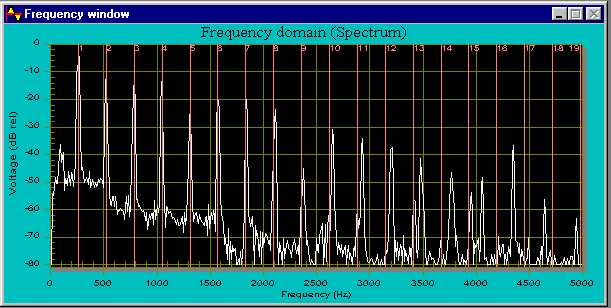
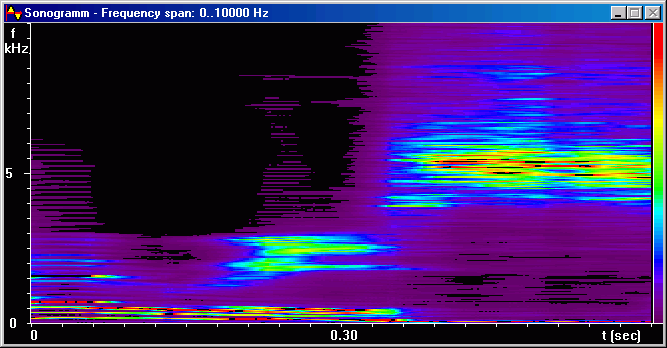
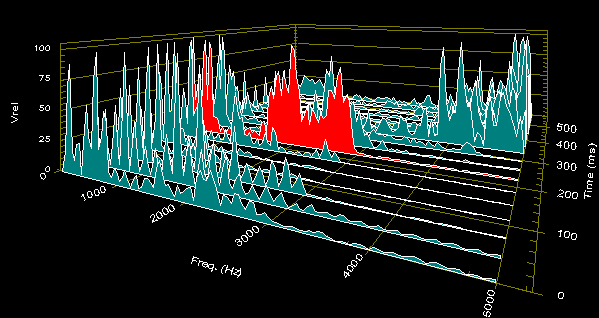
In analyser experiments you capture sound from the sound card or from a WAV file up to several seconds long, select the starting time of the time slice and analyse time and frequency responses. The example shows the spectrum of a piano playing a middle C (262 Hz). The non-harmonic overtones are clearly seen. (Due to the stiffness of the string, the frequencies of the partials are too high.)
Download version 1.15, June 2009: OVERTONE.ZIP
(1.55 MB)
Unpack in a new folder, read README.TXT and start OVERTONE.EXE
(Some firewalls or User Access Control (UAC) may block execution. Give OVERTONE the necessary permissions.
Make sure, that the sound device is not used by another application.)
For more information, send e-mail to address given in README.TXT
Unterrichtseinheit Analyse von Klangspektren von Alain Hauser (in German)
