Vault Girls Episode 9 -fall Out- -sound- Mp4 [work] Online
Beyond immediate plot and character work, the episode’s sound design asks a larger question about memory and media. What does a society remember when the records themselves are compromised? The MP4—a discrete, reproducible file—promises permanence but is vulnerable to corruption. The show toys with this tension: archival audio clips of pre-collapse life play like ghostly echoes, music snippets that once defined identity now sound chopped and foreign. Sound becomes a mode of historical layering; listening is a way of excavating the past, even when every fragment is partial and suspect.
Sound in "Fall Out" functions on three axes: narrative information, emotional texture, and ideological subtext. On the surface, sound advances plot: clipped radio chatter signals an approaching threat; the metallic creak of a vault door marks transitions between safety and exposure; an emergency broadcast, looped and distorted, converts background noise into an ominous character. These cues orient viewers in time and danger the way establishing shots used to in classic cinema. But the episode’s real achievement is how these signifiers are used to complicate trust. The radio—usually a reliable channel—becomes unreliable; voices overlap, lag, or drop out, so that what you hear is never the whole truth. The incompleteness of transmitted sound mirrors the information gaps between characters and between show and audience. Vault Girls Episode 9 -Fall Out- -sound- mp4
"Vault Girls" has always thrived on contrast: the veneer of adolescent camaraderie against the slow creep of an uncanny, post-apocalyptic world. Episode 9, titled "Fall Out," crystallizes that contrast, and doing so through sound—both diegetic and otherwise—becomes the episode’s most subversive device. When thinking of this installment in terms of "sound/mp4"—the audiovisual bundle by which most audiences first encounter it—we should listen not only to what the episode plays but to what it withholds, what it muffles, and what it amplifies. Beyond immediate plot and character work, the episode’s


Call us (08:30-16:00 UK)
01803 865913International
+44 1803 865913Need Help?
Help pages
Wildlife Survey & Monitoring
- Aquatic Survey & Monitoring
- Professional Hand & Kick Nets
- Water Testing
- Waders & Aquatic Safety
- Pond Dipping Equipment
- Plant Survey
- Tree Survey Equipment
- Quadrats & Point Frames
- Botanical Presses & Accessories
- Marking Tape & Marking Flags
- Amphibian & Reptile Survey
- Amphibian Survey & Monitoring
- Reptile Survey & Monitoring
- Scales, Balances & Holding Bags
Practical Conservation Equipment
- Bird Boxes
- Woodcrete & WoodStone Bird Boxes
- Bird Boxes for Walls & Fences
- Integrated Bird Boxes
- Wooden Bird Boxes
- Bat Boxes
- Woodcrete & WoodStone Bat Boxes
- Bat Boxes for External Walls
- Integrated Bat Boxes
- Wooden Bat Boxes
- Other Nest Boxes, Habitats & Feeders
- Insect Boxes
- Mammal Boxes
- Frog & Toad Habitats
- Feeders & Water Baths
- Wildlife Management
- Badger Gates & Fencing
- Invasive Species Control
- Amphibian & Reptile Fencing
- Predator Deterrents & Repellents
Field Guides & Natural History
Academic & Professional Books
British Wildlife
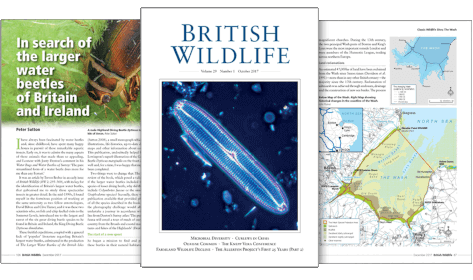
British Wildlife is the leading natural history magazine in the UK, providing essential reading for both enthusiast and professional naturalists and wildlife conservationists. Published eight times a year, British Wildlife bridges the gap between popular writing and scientific literature through a combination of long-form articles, regular columns and reports, book reviews and letters.
Conservation Land Management
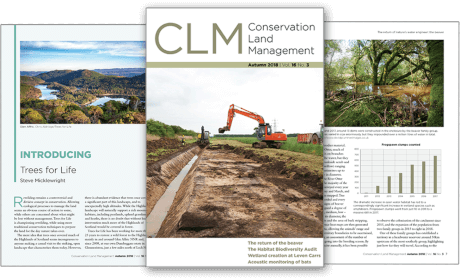
Conservation Land Management (CLM) is a quarterly magazine that is widely regarded as essential reading for all who are involved in land management for nature conservation, across the British Isles. CLM includes long-form articles, events listings, publication reviews, new product information and updates, reports of conferences and letters.